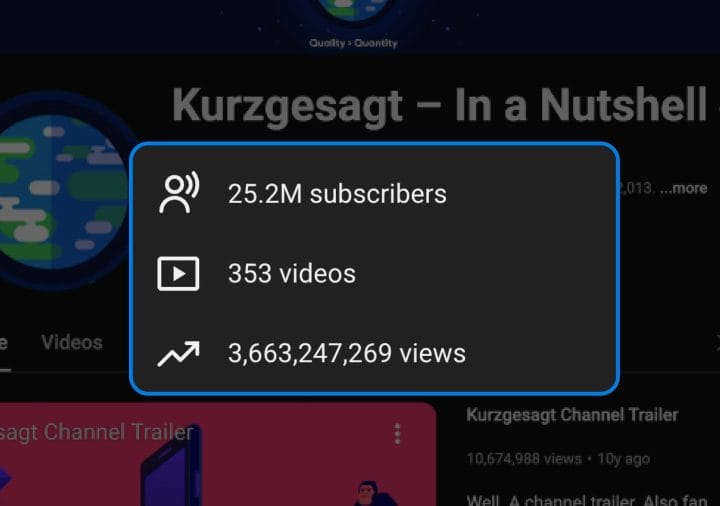
As of April 2026, 3.6 billion. That is the number of times people have chosen, voluntarily, without being asked, reminded, or assessed, to watch Kurzgesagt explain black holes, nuclear war, the immune system, and the philosophical implications of consciousness.
No completion target was set, and nobody’s quarterly review depended on watching.
That number is not a YouTube statistic. It is a statement about human nature. And it contains more insight about how people actually learn than most training programmes will accumulate in their entire existence.
Curiosity Is Not a Personality Trait. It Is a Drive State.
In 1994, behavioural economist George Loewenstein published a paper that changed how researchers think about curiosity.
His argument was precise: curiosity is not a characteristic that some people have and others lack. It is a response to a specific cognitive condition, the moment you become aware of a gap between what you know and what you want to know.
The keyword is awareness.
You can be ignorant of something for years and feel nothing. The moment someone makes you conscious of that gap, a drive kicks in to close it.

That drive is curiosity.
What happens next is equally significant. A 2014 study by neuroscientist Matthias Gruber at UC Davis found that when people were curious, their memory for the topic improved dramatically. Expected.
But the study found something stranger: people in a curious state also showed significantly better memory for entirely unrelated information encountered while curious.
Curiosity did not just sharpen focus on the subject at hand. It primed the whole brain for learning. Whatever you absorb while genuinely curious tends to stick, even the things that have nothing to do with the question you were trying to answer.
Curiosity is not the reward for good learning design. It is the precondition for it.
Kurzgesagt uses this deliberately.
Take their video on the immune system. It does not open with an objective. There is no “by the end of this video, you will understand how your body fights infection.”
Instead, the first line is closer to a gut punch: you have an entire defence system operating inside you right now, one of the most complex things in the known universe, and you have almost no idea how it works.
That single sentence does not give you information. It gives you the feeling of missing information. You suddenly notice a gap you did not know was there, and that gap creates a pull. You want it closed.
That is Loewenstein’s mechanism in action. They did not teach you about the gap. They put you right in the middle of it in under 15 seconds.
Curiosity-based learning design for complex topics.
Kurzgesagt did not invent curiosity-based learning design. They applied it on an exceptional scale.
The same logic applies wherever people genuinely choose to engage with something difficult.

David Attenborough has narrated nature documentaries for over six decades, including Planet Earth, Blue Planet, and Our Planet, and billions watched his work.
His narration works not because he delivers information efficiently, but because he deliberately withholds resolution. He says something like: “But these creatures face a challenge no other species has ever solved.” That line tells you nothing. But it makes you lean forward. The gap is open. You keep watching.

Radiolab is an American podcast about science, philosophy, and the big questions. It has run for over 20 years and consistently ranks among the most downloaded podcasts worldwide.
Every episode opens with a mystery the hosts refuse to resolve too quickly. They wonder aloud. They sit with the question before they answer it. The result: millions of people voluntarily spend their commutes wrestling with questions about immunology, linguistics, and moral philosophy. Nobody assigned it. The gap made it worth choosing.

Escape rooms have grown from a niche novelty into a global industry worth over 8 billion dollars, with venues in virtually every major city. The game works on a single mechanism: you walk in not knowing what you need to find, and every clue you discover opens up another question.
The motivation to solve those questions and discover more, under the pressure of a ticking clock driving a sense of urgency, is the entire experience. And this is the attractive part about it all.
And here is the telling detail: the hardest rooms, where only fifteen per cent of groups ever finish, have the longest wait lists. We can conclude that when there is genuine curiosity, the sense of difficulty does not deter people. It makes them want it even more!
Daniel Willingham is an educational psychologist at the University of Virginia, known for bridging cognitive science and classroom practice.
His decades of research into why students remember some teachers and forget others produced a consistent finding: the effective ones always open with a question or a problem, never with the answer.
They create the gap first, then fill it. The sequence is not a stylistic preference. It is functional. The drive state has to exist before learning can take hold.
The gap has to come before the answer. Always. This is not a stylistic choice. It is a neurological one.
Designing Learning Experiences with Curiosity

If curiosity is a drive state, triggered by specific conditions rather than a personality trait, then the question at the start of any learning experience design process needs to change.
Most learning design starts here: what do people need to know? That is a necessary question. But it is not the first one.
The better starting point is: what is the gap they do not yet know they have? That shift changes everything downstream.
Here are 4 principles worth considering the next time you design a learning experience:
#1 – Open with the gap, not the answer.
Before you reveal what the session covers, surface what the learner does not yet know.
A single well-placed question, one they cannot immediately answer, opens the gap. Once the gap is open, the desire to learn is triggered. This puts the content that is delivered to them in a different light thereafter.
#2 – Withhold resolution deliberately.
Most learning experiences resolve too early. They answer the question before the learner has felt the weight of not knowing.
Try presenting a scenario or a problem and do not explain it fully before asking the participants to engage with it. The discomfort of working within the gap is not a design flaw; it is actually part of the mechanism. Planned and purposeful!
#3 – Sequence information, not just content.
The same facts, delivered in a different order, produce different engagement. Information that arrives before the learner has a reason to want it tends not to stick.
Map the sequence of your content against the sequence of questions your learner develops, and make sure the gap always precedes the answer.
#4 – Replace learning objectives with opening provocations.
A learning objective tells the learner what they will receive. A provocation makes them feel what they are missing.
Compare these two ways of opening a session on handling difficult customer complaints:
“By the end of this session, you will be able to apply a four-step framework for managing escalated customer interactions.”
versus
“A customer calls in furious. They have been passed around three times, and they are about to go public on social media. You have thirty seconds to save the day. How will you respond?”
The first tells the learner what to do. The second puts them inside a problem that they have to act on. One creates compliance. The other creates drive.
The experiences that choose the gap over the answer build something no completion dashboard will ever measure, but that every learner carries out of the room.
Think back to something you genuinely learned, something that changed how you think or how you work. Did it begin with an answer? Or did it start with a question that drew you in that you could not leave alone?
Try the same test on your own scrolling habits. When you stop mid-feed and spend 3 minutes reading something you never planned to read, think about what pulled you in. A headline that told you what to think? Or one that opened something you suddenly needed to close?
Most eLearning today is still built the other way around. The answer arrives before the learner has any reason to want it, and the content lands on people who have no reason to care.
That is not a technology problem. It is a design-starting-point problem.
And it is one worth revisiting.
Looking to build learning experiences that people genuinely choose to engage with?
We would welcome the conversation.
Reach us at [email protected] or click here to contact us.
View this post on Instagram