In a world overflowing with information, meaningful learning is defined by what changes as a result.
Imagine a typical working day for a modern professional. There are meetings to attend, decisions to make, and discussions to move work forward. Between sessions, there are emails to clear, documents to review, messages to respond to, and plans to prepare.
When the workday ends, attention does not stop. It shifts. There is a child’s homework to check and household matters to manage. And when there is finally a moment of personal time, it is often spent scrolling through a stream of short videos, news, opinions, and advertising. It is a rapid mix of information that informs, distracts, challenges, or simply fills the silence.
In reality, this is how modern life is.
For learning design, this context matters. Learning no longer happens in quiet, protected spaces. It competes with constant inputs, real responsibilities and many distractions.
So what does this mean? It means that learning effectiveness is no longer judged by information delivery but by how effectively it supports thinking and decision-making on matters that matter.
The Traditional Model
Traditional instructional design often follows a familiar, logical, linear formula of Know, Connect, Do. It starts with knowing what learners need to learn, connecting with them to motivate their desire to learn, and then hoping they eventually apply what they learn.

As they say, “hope is never a strategy”, especially so in today’s environment.
This way of instructional design assumes that:
- Knowing naturally leads to creating what learners need
- Motivation is secondary and can come later
- Learners are just waiting passively to be imbued with knowledge
And sprinkle in a healthy dose of “hope”. However, learners’ needs have evolved, and this approach no longer works.
They are time-poor, cognitively loaded, and increasingly driven by relevance. They don’t want to learn everything. They want to know just enough to move forward confidently, quickly, and meaningfully.
So the model needs to change.
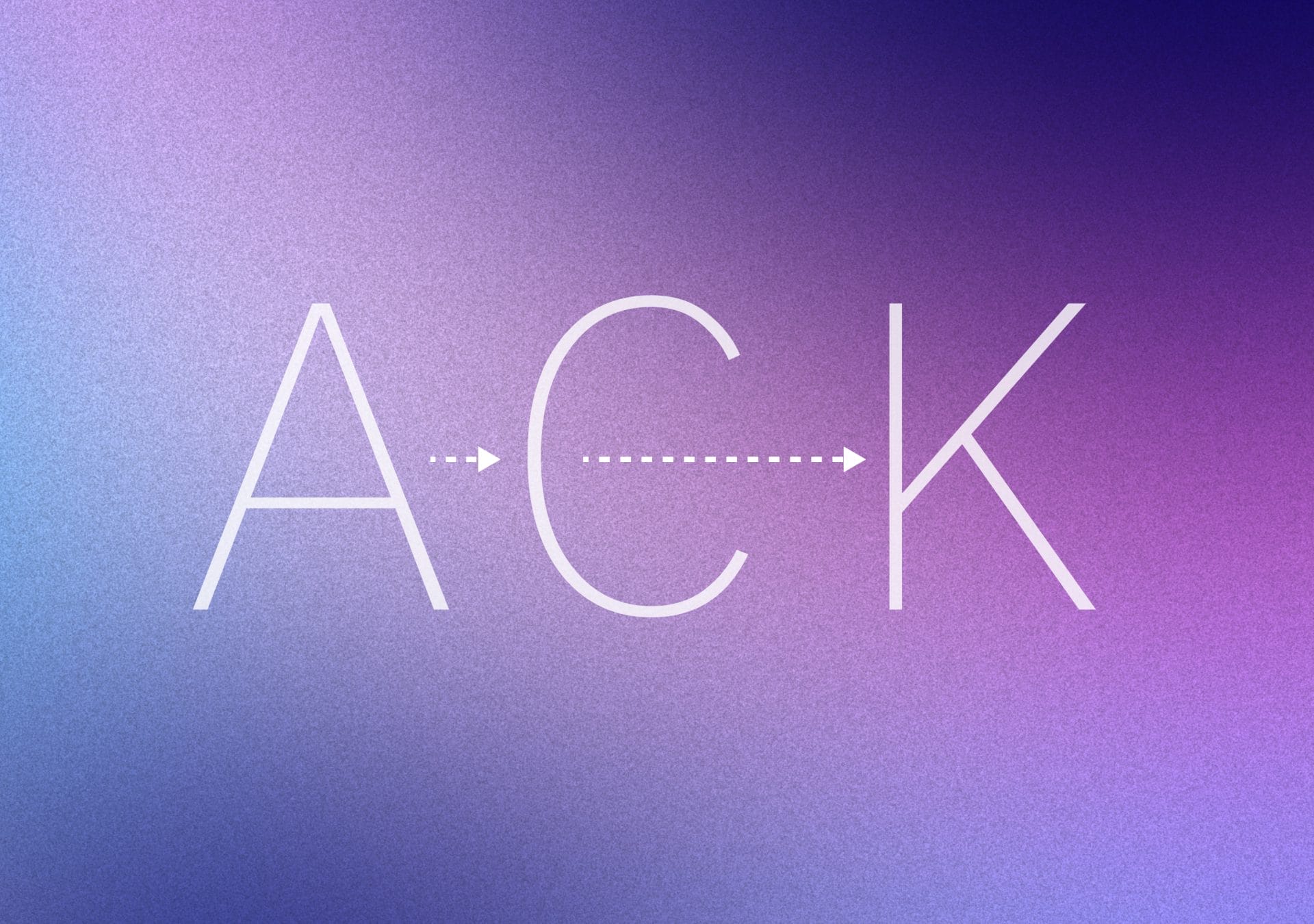
Introducing Act-Connect-Know (ACK)
At Visuer, we use a design lens called Act-Connect-Know (ACK) that flips the traditional approach to place experience, emotion, and action at the centre of every learning decision, enabling the design of learning that works in the real world.
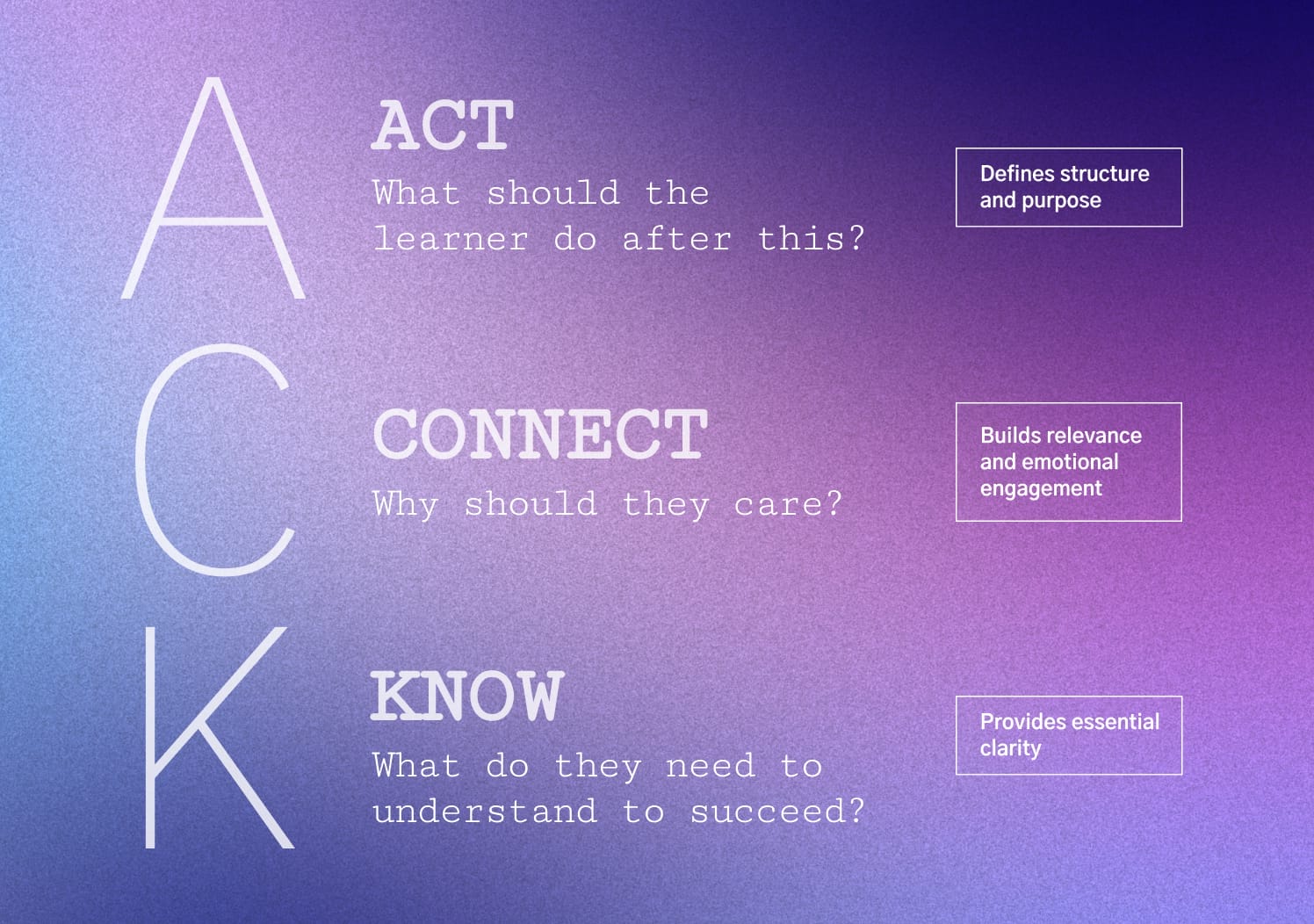
ACT
Effective learning starts with behaviour.
The most important question to ask at the outset is simple:
What will the learner do differently as a result of this learning journey?
When the action design takes priority, the rest falls into place. It prevents learning from becoming a content-driven exercise and keeps the focus firmly on action rather than knowledge alone.
Whether it’s about giving more precise feedback, spotting risks more quickly, making more effective decisions, or handling a difficult conversation, the action is what underpins the whole experience.
CONNECT
When the learner feels the learning is human, it sticks.
Once the action is explicit, the next question is a natural one:
Why will the learner care enough to take action?
Emotion is not a nice-to-have in the learning process; it’s what makes it memorable. Relevance, motivation, urgency, and empathy are what drive learning.
Connection is not always easy. Sometimes it requires:
- Seeing the actual impact of poor judgment
- Seeing themselves in a realistic situation
- Being challenged in a way that is tough but not punitive
KNOW
Knowledge exists to serve action, not compete with it.
Only once action and connection are defined can knowledge be included.
Knowledge is not there to impress and awe; it’s there to enable action.
Instead of asking, “What knowledge do we need to include?” ask:
- Which misunderstandings need correcting?
- Which frameworks actually help us make better decisions?
- Which examples actually help us understand, rather than confusing us?
A Practical Illustration: Designing Sales Learning That Invites Engagement
Sales training is challenging. It needs to demonstrate results quickly, respect the experience of seasoned professionals, and often fight for time and attention.
One increasingly popular approach is to design sales learning experiences that feel lighter, more exploratory, and closer to real life, and apply them to their everyday work, without losing rigour or intent. The goal is not to remove structure, but to change how learners experience and take away from the learning.
ACT:
Focusing on clear, observable shifts
Rather than trying to improve everything at once, this approach begins by identifying one actionable behaviour that would make a real difference in sales conversions.
For example, instead of a broad learning objective such as “improve selling skills”, the focus can be on a more specific shift. For example, developing successful conversation starters, asking the right diagnostic questions, and knowing when a pitch is too early or aggressive.
This provides clearer learning directions. Success is not measured by how much content is completed, but by the results garnered by this behaviour.
CONNECT:
Creating space for reflection, not instruction
To make this behaviour meaningful, the learning experience should include short, interactive scenarios that mirror everyday sales conversations and experiences.
For example, a customer engagement begins with great promise. The discussion was going well. Points exchanged were useful and relevant. Then, somehow, momentum fades, and the opportunity dulls away.
Rather than just explaining outright what went wrong, invite the learner to respond at key moments and demonstrate the different outcomes. Some responses end the conversation prematurely, while others keep it going on a positive trajectory.
There is no need to create right or wrong labels. No corrective messages. Just consequences and results that are familiar because they actually happen in real life!
Because the situations closely reflect what they experience, the learners will naturally begin to reflect on their own.
“I’ve had this conversation before.”
“I usually rush through this part.”
“I didn’t realise how early and aggressive I was at my pitch.”
These kinds of reflection build motivation without needless pressure. This process does not dictate to learners to change; it helps them notice what is worth changing.
KNOW:
Supporting experimentation with just enough clarity
Knowledge becomes even more useful after reflection.
Instead of shoving a complex, heavy framework down learners’ throats upfront, a simple, structured process of questioning is more effective when offered as a support tool. The questions can guide learners to replay parts of the scenario to hear how the conversation shifts.
The knowledge is deliberately light and focused. It is not presented as something to memorise, but as something to try.
This respects how people actually learn at work. In short timeframes, learning is more about triggering better thinking and decision-making at the moment, which also promotes retention.
How this aligns with Act–Connect–Know
In this example:
- Act defines the purpose by anchoring learning in a specific behavioural shift
- Connect creates relevance through realistic situations that prompt self-reflection
- Know provides clarity only when it supports action, not before
Together, they create an engaging, practical learning experience that is respectful of the learner’s time and expertise.
Rather than forced learning, the design creates the conditions for motivation. And when learners are motivated to try something differently, learning has a far better chance of carrying through into real work.
Act – Connect – Know (ACK) requires a shift in mindset
ACK changes our approach to learning from our existing information-first mindset, where success is measured by what gets covered, to a more outcome-first mindset, where success is measured by what learners can actually do differently as a result.
Knowledge is no longer the goal, but rather a means to that goal.
At the same time, our approach to engagement is no longer something that gets added at the end, after the content is built. Rather than “making it engaging” at the end, our approach is to “design it in” from the very beginning by making sure that our learning connects to real actions, real consequences, and real relevance to our learners’ world.
This, in turn, leads us to shift away from content delivery toward experience design. Learning is no longer something that gets “delivered” to our learners, but something that our learners “move through”, “make sense of”, and “apply.”
Together, these shifts reframe learning as a human experience that supports meaningful change in the real world.
When designing your next learning initiative, let every format, interaction, and decision be guided by one question:
What must the learner do, feel, and understand to grow?
That’s the lens true Learning Architects use every day.
Ready to build learning that deliver impact?
If you’re exploring new ways to increase the impact of your learning initiatives, we’d be glad to share a strategic perspective.
Email us at [email protected] or click here to contact us.
View this post on Instagram